Tea with the Taliban
Everyone has to make a living. Some ways of making one aren't worth the money.
A few weeks ago I updated my resume and my LinkedIn. I'm not looking for a new job. I like where I work, and I hit the lottery with a company that's done a lot for me and actually cares about people, which is rarer than it should be. But apparently rearranging 26 letters of the alphabet is all it takes. Recruiters ignored me for eleven years, and now, a couple of edits later, they're lining up to talk. It's very odd, but that's how things work.
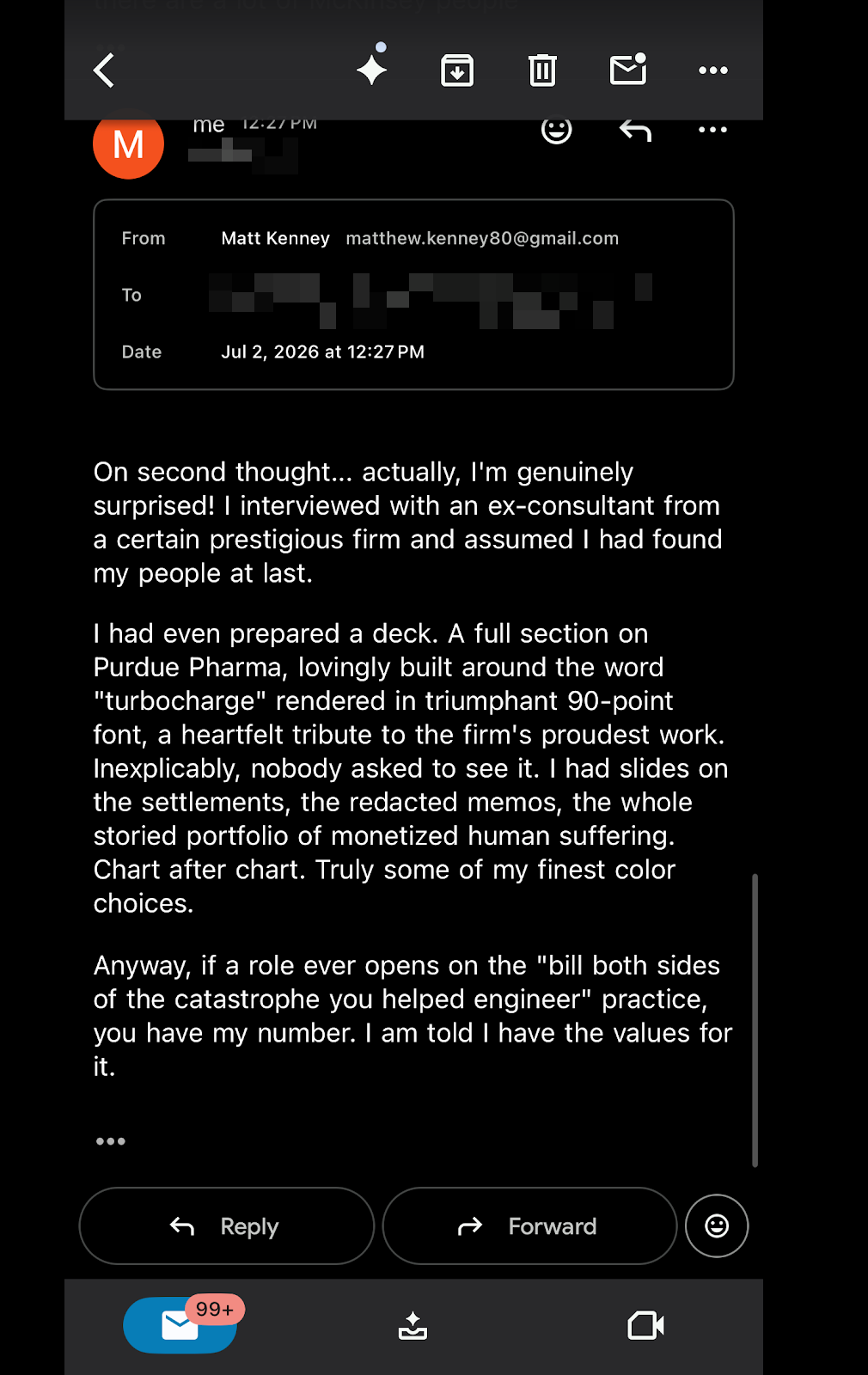
So I took an interview on a lark. Moderately interesting product, good pay, nothing I'd leave my job for. The interviewer was very self-assured. He mentioned, with some pride, that he and most of his colleagues were alumni of a particular consulting firm. I won't name it, but you know the one. Captains of industry cut their teeth there. Politicians, thought leaders, cultural leaders. They're known for making excellent PowerPoint decks.
About twenty-five minutes in, I decided to take the interview off-road and into a ditch. That was the intended purpose. There are other jobs, and I was never taking this one.
A few days later the recruiter emailed on the interviewer's behalf: "Matthew, we liked you, but you're not moving forward." Fine by me. I sent a polite thank-you.
And then something clicked. It was an urge, the kind you can't stop. I'm addicted to nicotine, and it felt exactly like that. I had to scratch it, I had to write something, I had to hit send.
Because that firm did something years ago that I find unforgivable. Worse than the tobacco companies, in a way. Everyone knew tobacco was bad; we got addicted with our eyes open, and that's on us. This was different. This firm consulted on the opioid business. It advised on how to turbocharge the sales engine, how to get more pills into more hands and keep them there. They didn't call it scaling an epidemic. But that's what the plan did.
I grew up in the Florida Keys. In the late nineties my uncle got hooked on prescription pain pills, and I watched what they did to him. He stole my grandmother's Percocet, a 300-count of Vicodin. My mother once went to the pharmacy and the pharmacist said, "Oh, your brother already picked up the prescription." My uncle went to jail for stealing a prescription pad. I saw, up close, what these pills do to people.
Then, in the 2000s, they hit my town like a freight train. Seven people I was close to are gone now, overdoses or something pill-adjacent. I've lost count of the way you lose count of these things, which is to say deliberately.
The pills killed my uncle too. Mid-fifties. An insanely talented man: a chef, a photographer, a hockey player, Bill Clinton levels of charisma. He could level a room. He just understood people; there was a force to him. That force came with its own dark side, mostly the addiction. He overdosed in a Vegas hotel room, and it was not the Bellagio.
We never buried him. His ashes are in an urn, and every year we put the urn under the Christmas tree and wrap it like a present. I think he'd have gotten a kick out of that.
So that was the urge. I wrote back to the firm and gave them some advice. Cynical, deadpan, professional advice on how they might have scaled the opioid crisis a little differently, a little more efficiently, if efficiency was really the thing they were after. It was profoundly cynical and I have no regrets. Everyone needs to make a living. But some things are inexcusable, and I'll burn that bridge every single day.
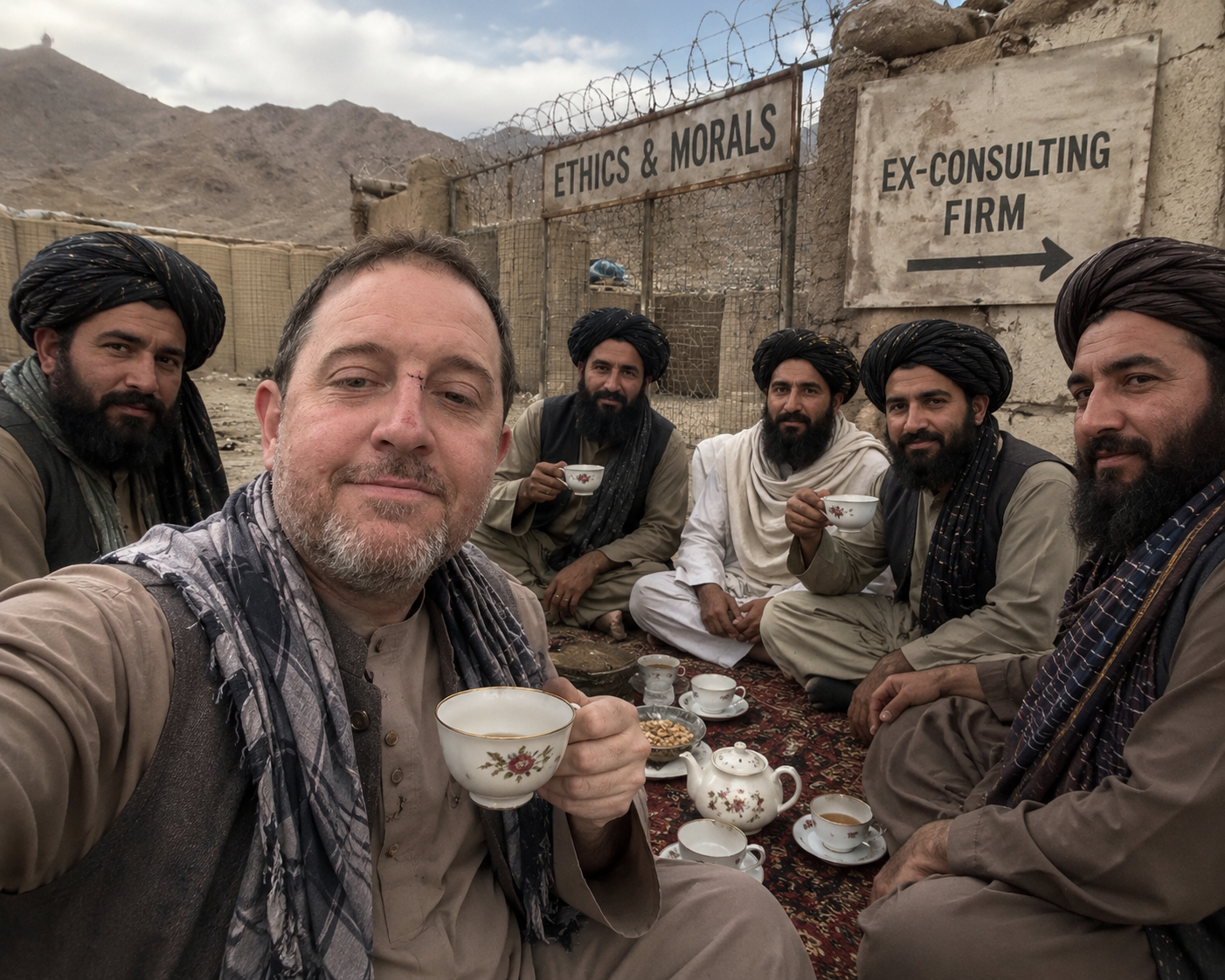
I was telling this story to a friend, and for some reason I thought of the Taliban. I'd read a book about Afghanistan once, "The Forever War" by Dexter Filkins, and I came away understanding that the place is unconquerable. Not just militarily. Spiritually, culturally, geographically, you cannot take it. Nobody can, and nobody has. And those people believe something. I might not agree with a word of it, but they really believe it. As a child my father worked undercover for the DEA. My mom told me he was almost stationed in Kabul, but we didn't want to live there, and I don't blame him. Afghanistan was wild in the '80s. But I just thought of tea, and the Taliban, and how I'd rather have tea with the Taliban than work with anyone at that prestigious firm, current or ex.
Tea with the Taliban. I like that it's got a nice ring to it. And say what you want about them: they believe in something. It's not good. But they believe in something, and it isn't profit.