The Interval
My father sold nothing wrapped, hunted men who sold the wanting, and died of the legal molecule. A story about dopamine.
Thirty years ago nobody knew much about the brain. The brain belonged to specialists, and the rest of us got by on gut feelings and the occasional aspirin. The same was true of therapy language. Now your barber has boundaries. Your cousin is processing. And everyone, to a person, knows what dopamine is. The smartest people I know can tell you about dopamine. The moderately intelligent can tell you about dopamine. None of them are right. But they all think they are.
The popular version goes like this. Dopamine is the pleasure chemical. You get the good thing, you get the hit. Tidy. Wrong. Dopamine is not the good thing. It is the anticipation of the good thing. It is the prediction that something could happen. This is why gambling is addictive, and sports betting, and speed dating, and the slot machine dressed up as a prediction market.
I have been teaching my children this, and the example I use is Christmas. Christmas evening feels good. Full, warm, ordinary. But Christmas morning, that feeling walking down the stairs, that is dopamine. You do not know what you are going to get. The wrapping paper is the whole chemical.
I know this because my father ran the control group.
My father never wrapped presents. I carried that memory for forty years, half convinced I had invented it, because I have a good memory and even a good memory learns to doubt itself. Then his ex-wife sent me photographs. A Christmas tree in Dorchester, early eighties, and under it the presents sitting there naked. No paper. No tape. No ribbon. You came down the stairs and the answer was already waiting.
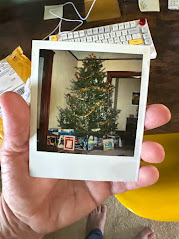
So my dopamine never crashed at my father's house. It never fired. There was nothing to anticipate. Other kids tore into mystery. I took inventory. Christmas morning arrived pre-solved, and my father, who could not have named a single neurotransmitter, had defeated the most powerful reward circuit in the human brain with laziness alone.
My father was an undercover DEA agent in the late seventies and eighties. He spent his working life inside the anticipation economy, buying from the men who sold the interval, wearing a wire against the wanting business. And, not ironically at all, he had a drinking problem. He died at forty. The man chased the illegal molecules for a living and the legal one got him. I have had my own problems with drugs and alcohol, off and on, throughout my life. The circuit does not care whose son you are.
Because of him, or in spite of him, I have always been fascinated by drug dealers. The economy of it. The cloak and dagger. The secrecy, the territories, the supply chains run on handshakes and fear. Strip away the sinister framing and you find something almost boring underneath. Everyone is just trying to make a living. Some livings are distinguished. Some are sought after. Some you are proud to tell your kids about. We decided his product was a menace and his career a tragedy, and we put men like my father on him.
The scientists needed monkeys and juice to prove what Dorchester already knew. The dopamine did not spike when the monkey got the juice. It spiked when the light came on that meant juice was coming. The reward was almost beside the point.
The slot machine understood this before the scientists did. Nobody ever pulled a lever because winning felt good. Winning feels fine. Ordinary, even. What feels like electricity is the half second while the reels are still spinning and anything is possible. The casino does not sell money. It sells the interval. Prediction markets sell the same interval with a Bloomberg terminal aesthetic so you can tell yourself it is research. Falling in love, if we are being honest, runs on the same circuit. Not the person. The maybe. Ask anyone who has been married for twenty years and then ask them about the third date.
The interval is the product. Remember that, because some very smart people did.
In the early two thousands, a generation of engineers and executives sat down with behavioral psychologists and asked a simple question. How do we make the interval permanent. There was a lab at Stanford that taught persuasive technology the way other departments taught thermodynamics. Its graduates went to Facebook, to Google, to the companies building the feeds. The pull-to-refresh gesture is a slot machine lever. This is not a metaphor. The man who helped design that world has said so, publicly, with the haunted look of a chemist reading about his compound in the newspaper. Variable reward schedules. Intermittent reinforcement. The same math B.F. Skinner used on pigeons, shipped to a billion phones with a friendly blue interface.
They took the most reliable finding in behavioral science and pointed it at children.
Here is what I have never been able to get past. Subliminal advertising is banned. A single frame of BUY POPCORN spliced into a movie was considered so sinister that governments moved against it, and the study behind it turned out to be a fraud anyway. We outlawed a ghost. Meanwhile the deliberate, documented, peer-reviewed engineering of compulsion loops into products used by my three children is not a scandal. It is a business model. It is a growth team. It has an offsite in Cabo.
A frame of film aimed at adults was a crime against the mind. A dopamine engine aimed at eleven-year-olds is a career.
And people want these careers. The line out the door. The stock options. The recruiters calling it a mission. Nobody in that building thinks of himself as the guy who runs the interval. He thinks of himself as connecting the world.
But the tell was always the children. Not ours. Theirs.
The drug dealer does not let his kids use the product. This is the oldest rule in the trade, the one my father knew from the other side of the wire. The dealer in Newark understands exactly what he is selling, which is why his own children are off limits. We call that man sinister. We built an agency to hunt him. Nobody offered him a TED talk.
Steve Jobs did not let his kids use the iPad. Said so to a reporter, casually, the way you would mention not keeping a gun in the house. Chamath Palihapitiya, who ran growth at Facebook, who scaled the machine as well as anyone alive, said his kids were not allowed to use that stuff and admitted to tremendous guilt about what he built. Sean Parker wondered aloud what it was doing to children's brains, after the check cleared. The executives send their kids to schools in Silicon Valley where the screens are banned and the toys are wooden. The tuition is paid in interval money.
Same rule. Same trade. Different framing. The only real difference I can find is the quality of the tailoring. The dealer in Paterson will never be invited to speak at a graduation. The dealer in Palo Alto is the graduation speaker.
The drug dealers will not let their kids use the drugs. The Silicon Valley executives will not let their kids use the drugs. Your kids are going to use them. They are going to use them all.
The old vices at least had the decency to wait for you. The casino needed you to drive there. The bar needed you to walk in. This thing is in your pocket at the funeral, at the dinner table, in the bed. It fires the light that means juice is coming, and there is no juice, there was never going to be juice, there is only the next light.
The monkey keeps pressing. The monkey is nine years old.
And somewhere a man who understands the circuitry better than anyone on earth takes his own child's phone, puts it in a drawer, and locks it. He knows exactly what he built. That is why.