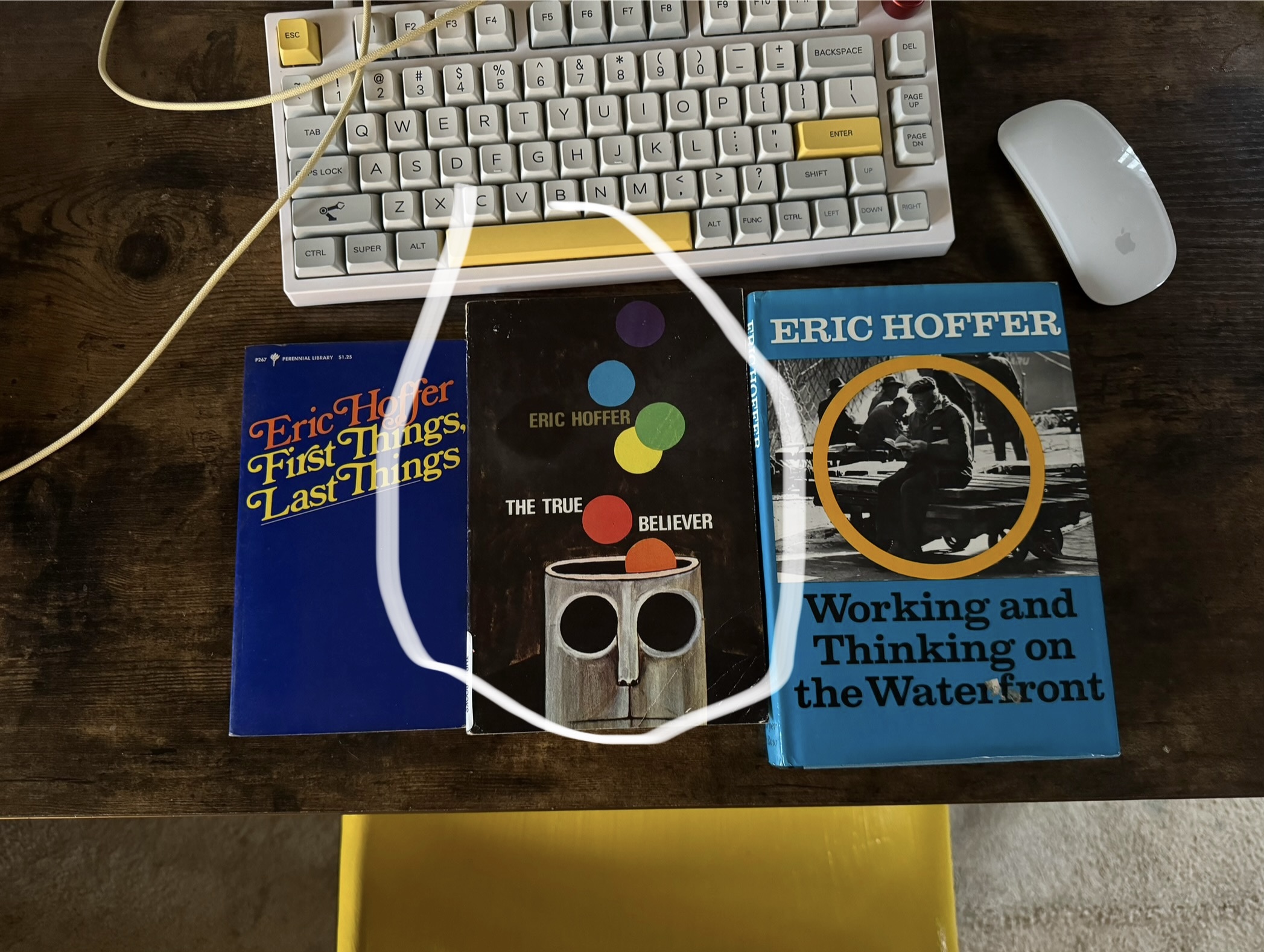
The Two Books
Eric Hoffer and Arthur Koestler figured out why smart people believe terrible things. Twenty-odd years later, I still can't unsee it.
Many years ago I ran into a line from Eric Hoffer: every great cause begins as a movement, turns into a business, and ends up a racket. It resonated hard enough that I went off and read everything the man ever wrote. Around the same time I learned that Christopher Hitchens reread Darkness at Noon once a year, every year, without fail. I'm 46 now, and I can say without much exaggeration that those two books have shaped how I see the world more than almost anything else I've read. So let me tell you what they're actually about, and why I keep going back.
Every couple of years, someone you respected (smart, funny, reads real books, once talked you out of a bad opinion) announces that they've finally figured it all out. The problem is a group of people. The solution is total, and obvious, and the only thing standing in its way is cowardice. What's unsettling isn't that they believe it. People believe things. What's unsettling is that they've gotten better at arguing since they went under. There's no crack in it now. Tighter than yours. You press on it looking for the place it gives, and it doesn't.
Nobody warns you about that part. We're raised on the comforting theory that terrible beliefs are a stupidity problem: that if people just read more, thought harder, got the facts, they'd come around. It's a nice theory. It happens to be backwards. The most dangerous believers I've watched are not the dim ones. They're the ones with enough wattage to build a cathedral around a bad premise and then live in it.
If you want to understand how that works, you don't need a shelf of political philosophy. You need two short books, both written by men who got close enough to feel the heat and lived to describe the damage.
The first is Eric Hoffer's The True Believer. Hoffer was a longshoreman who wrote philosophy between shifts on the docks, and he had zero patience for the flattering idea that people join movements because they weighed the evidence and were persuaded. They join, he says, because they can't stand being who they are. The movement offers a trade, and it's a good deal: hand over your small, disappointing, mortal self, and receive in exchange a share of something enormous and undying. You stop being a guy with a bad job and a failed marriage and become a soldier in a holy war. Who wouldn't take that? The facts are almost beside the point. Hoffer notes that mass movements are basically interchangeable, that the same frustrated person will flip from one to its opposite without much friction, because he was never in it for the content. He was in it to stop being himself.
That explains how people walk in. For how they can't walk out, you need Arthur Koestler's Darkness at Noon.
Koestler's Rubashov is an old revolutionary arrested by the revolution he helped build. He's interrogated, and over the course of the book he reasons himself into confessing to crimes he never committed (sabotage, treason, plots that exist only on paper) and then into dying for them. Here's what I can't shake: he isn't tortured into it, not really, and he isn't stupid. He's the smartest man in the book. He confesses because he still believes the premise. The Party, as he puts it, denied the free will of the individual and at the same time exacted his willing self-sacrifice. For the stubborn inner voice that keeps objecting, the conscience, the first-person I, he has a contemptuous name: the grammatical fiction. Once the self is a fiction and the Party's forward motion is the only fact, his guilt or innocence is a rounding error, and the logic runs clean to the cellar where they shoot him. His intelligence isn't his defense; it's his executioner. He's too rigorous to find the exit, because the exit means saying the one thing he can't: the premise is wrong.
Put the two together and you've got most of politics, and a fair amount of human nature besides. Hoffer tells you why people surrender themselves to a cause. Koestler tells you why, once they have, no argument can reach them: they're not defending a conclusion you can refute, they're defending the floor they're standing on. The villain in both books is the same, and it isn't ignorance. It's a certain kind of cleverness with nowhere good to go. Give a frustrated, capable person a premise that makes their pain mean something, and they will out-argue you for the rest of their lives.
Which is bleak, so here's the one consolation. The thing that saves you was never being smart. Smart is the delivery mechanism. It's keeping some ungovernable, un-absorbable scrap of yourself back from the collective, the part that can look at a beautifully constructed argument ending in a firing squad and say, plainly, no, I think this is insane, without being able to prove why on the movement's own terms. Rubashov's tragedy is that he traded that scrap away years before they ever arrested him. By the time he needed it, it was gone.
Read the two books back to back some weekend. Then think about the last person you knew who went under, and the last time you felt the pull yourself. That's the uncomfortable part. Hoffer and Koestler aren't writing about them.